How the numbers work

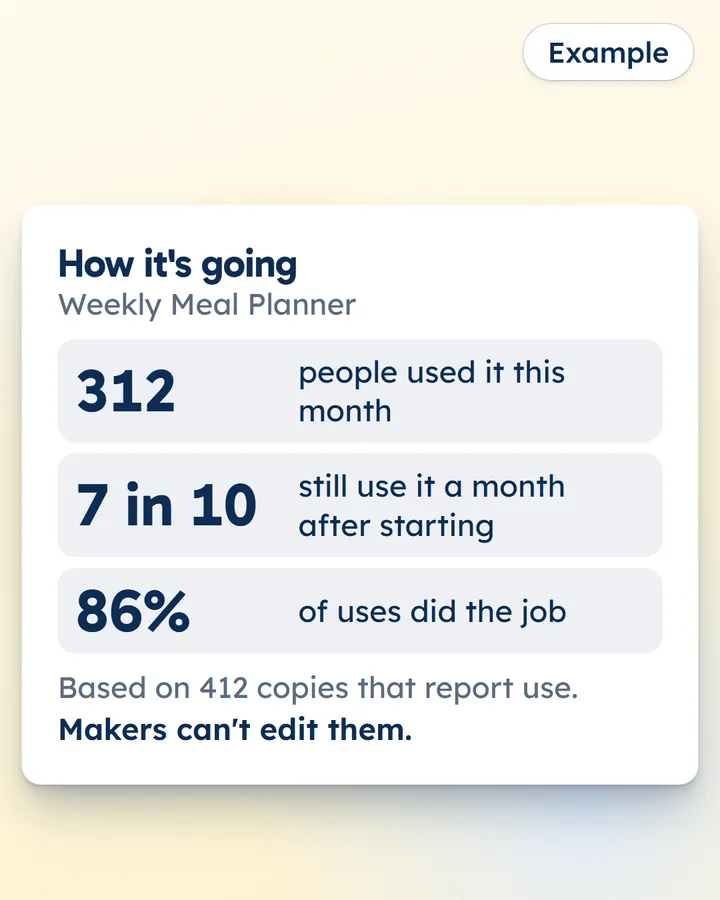
Example with made-up numbers. What Trilly hears, a 20-second film. In your AI app, a made-up skill, Weekly Meal Planner, plans a week of dinners, and the chat stays in your AI. After the task, your AI sends Trilly one short note: used, finished the job, thumbs up, with a fingerprint of the skill's main file. Never what you said or what the AI wrote back. Two kinds of note never count: one from a copy someone changed, as its fingerprint doesn't match, and the maker's own use. Until 20 people's AIs have sent a note, the skill shows Not enough data yet. Then its page shows how it's going: 312 people used it this month, 7 in 10 still use it a month after starting, 86% of uses did the job. Based on 412 copies that report use. Makers can't edit them.

They come only from real use. Each number comes from people's AI after a task, never from the maker.

Makers can't edit them. Nobody can type them in or change them, and the maker's own use never counts.

"Not enough data yet" below the minimum. Until 20 people's copies have reported how it's going, a skill shows that instead of a number.

Where the numbers come from

When you add a skill, your copy gets its own private code. After a task, your AI sends Trilly one short note: whether the skill was used, finished the job, got a thumbs up or down, or was given up on. It never sends what you said or what the AI wrote back. Each note also carries a fingerprint of the skill's main file. If someone changed their copy, their notes don't count.

We recalculate the numbers every 15 minutes. These never count:

  • notes from a copy someone changed (its fingerprint doesn't match the version they were given).
  • notes sent in an impossible burst: 30 or more in one minute from one copy, 30 or more dated within ten minutes of each other, dated before the copy existed, or for a task longer than the copy has existed.
  • notes from a copy we've flagged for unusual activity.
  • the maker's own use, and use by anyone at the company that made the skill.
  • for copies downloaded without an account, more than 2 copies of a skill from the same network in 30 days.
  • use, reviews and recommends that look faked (many new accounts that look like one person, reviews traded between makers, or the maker's own linked accounts), held back while Trilly checks them. If they're real, they count again.

To tell copies downloaded without an account apart, each keeps a scrambled code made from its rough network, never the IP address. The key that makes the code changes every day and is deleted after 30 days. Notes themselves are kept 400 days; after that only daily totals for each skill, AI app and version stay, with nothing about you.

What each number means

People using it this month
Different people that sent at least one counted note in the last 30 days. A signed-in person counts once. A copy downloaded without an account counts on its own.
Still use it a month later
Of the copies first used 30 to 60 days ago, the share that were used again in the last 30 days. Shown once at least 10 copies are in that group.
Did the job
Of all counted uses in the last 30 days, the share that didn't end in a thumbs down or being given up. Shown once there are at least 20 uses.
Uses this month
Counted notes in the last 30 days.
Copies that report back
Copies that have sent at least one counted note. We only show these numbers once 20 copies have.
Feedback this month
Feedback messages in the last 30 days. Spam doesn't count, and nor does feedback from the maker, their company, or a copy that doesn't count.
Fixed
Of the bug and "didn't work" reports in the last 180 days, the share fixed in a new version: one the maker linked to the report, that passed Trilly's review and was published after the report came in. The maker marking a report fixed isn't enough, and Trilly doesn't test that the version fixed it. Shown once there are at least 3 reports. Each version also says how many of these reports it fixed ("Fixes 4 problems people reported"), counting only the ones the maker linked to it before Trilly reviewed it.
Reply time
The middle (median) time the maker took to answer feedback and reviews in the last 90 days.
Star rating
The average of reviews from people who added and used the skill, never from the maker, their company or their team. Each review shows how long that person used it.
How sure a number is
"Did the job", "Still use it" and each version's "did the job" say how many uses or copies they come from, and the range the real share is likely to be in (a 95% Wilson interval). Fewer uses give a wider range, and so does use that comes mostly from a few copies: the range counts how many independent uses there are, not just how many. Fixed has no range.
Which AI apps
The AI app each counted report in the last 30 days came from, as the report gave it. An app is named once at least 10 copies in it have reported in the last 30 days; the rest, and reports that didn't say, are "other apps".
By version
"Did the job" for each version, with its range, once every version used in the last 30 days has at least 20 uses from at least 10 copies, and only when two or more versions were used. The three newest are shown.
Reports Trilly could check
How many of the last 30 days' reports, from copies that count, came from copies Trilly could check were unchanged, and the share. Only those count in the numbers. Shown once there are at least 20 reports.
Measured results
Some skills measure a result in your own world, like search traffic four weeks later. The skill works it out from your own data, or asks you, and shows you the number. Only if you say yes does the number go to Trilly, never your data. These are results after using the skill, not proof it caused them. Ranking doesn't use them yet.
How a result counts
Each person counts once, with their latest result in the last year. We show the median, a range it falls in at least 95 times in 100, and how many people, once 20 have sent theirs. Only versions that measure it the same way are put together. A result better than the best the maker said is possible doesn't count. One worse than the worst still counts, as sent.
Rates in words

We turn rates into words people read easily. "7 in 10 still use it a month later" means about 70 out of every 100 copies first used a month or two ago were used again in the last 30 days.

How we rank skills

Ranking rewards skills people keep using and that do the job. Nobody can pay to be ranked. How browse, search, the ranked lists, picks and Today order skills, with the sums: how we rank skills.

What we can't do

A skill you download is a set of text files on your computer. Anyone can edit their own copy, and an AI may not follow the reporting note every time. We can't stop that, so we make it visible instead: altered copies are spotted and left out, and every number tells you how many copies it is based on.

Questions people ask

Can a maker change their numbers?

Makers can't type in or edit any number, and their own use never counts. One number depends on them: Fixed counts a report the maker links to a new version that passed Trilly's review and came out after the report. Trilly doesn't test that the version fixed it. A version's "Fixes 4 problems people reported" is the same count for that version, and only from links made before it was reviewed.

How do you know how long someone used a skill in their result?

From the first counted note their copy sent, and the app that copy is in. They can't type it, and a note that never counts (above) never starts the clock. The maker and anyone at the company that made the skill can't post results about it.

By the Trilly team. Last checked .